
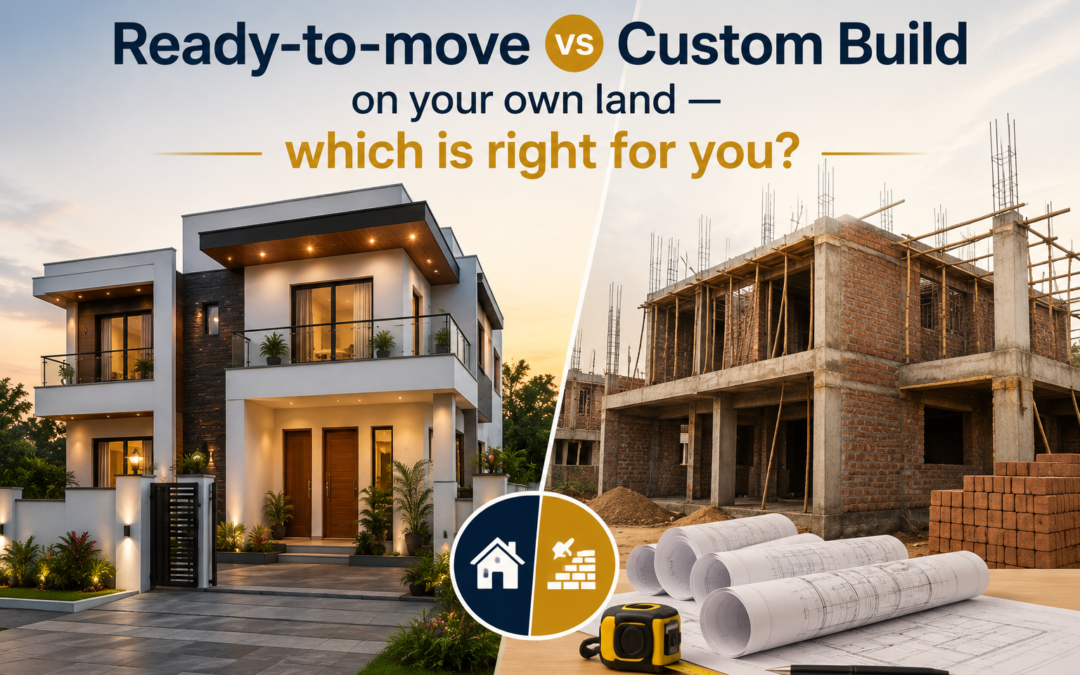
Quick answer: Ready-to-move vs custom build on your own land comes down to three things — time, control, and budget. A ready-to-move home is finished or nearly finished, so you can move in fast, with a fixed price and no construction stress. A custom build on your own land takes longer and needs more of your involvement, but you get a home designed around your exact needs, your plot’s shape, and your family’s future. If you want speed and certainty, pick ready-to-move. If you want full control and a home built only for you, pick custom build.
Buying or building a home is one of the biggest decisions you will ever make. It is not just about money. It is about where your family will live, grow, and make memories for the next twenty or thirty years. So when you sit down and compare ready-to-move vs custom build on your own land, you are not just picking a construction method. You are picking a lifestyle.
This guide breaks down everything you need to know. No jargon. No confusing terms. Just simple, honest information to help you decide.
What Does “Ready-to-Move” Actually Mean?
A ready-to-move home is a house that is already built, or is close to completion, on land the builder already owns. You walk in, you see the actual rooms, the actual walls, the actual view from the window. There is no guessing.
Most ready-to-move homes come in standard layouts — 2 BHK or 3 BHK — built on a piece of land the construction company has already developed. The builder handles the design, the approvals, the construction, and the finishing. Your job is simple: choose the unit, check the documents, and move in.
This option works well for buyers who:
- Need a home urgently, maybe due to a job change or family need
- Want a fixed, known price with no surprises
- Do not want to manage construction workers, material orders, or site visits
- Prefer to see the actual home before paying the full amount
When people search for “ready-to-move vs custom build on your own land,” a large number of them are actually comparing these two options because they are short on time. Ready-to-move solves that problem directly.
What Does “Custom Build on Your Own Land” Mean?
A custom build on your own land is exactly what it sounds like. You already own a plot — maybe it was inherited, maybe you bought it years ago — and now you hire a construction company to design and build a house on it, based on your requirements.
Every wall, every room size, every window position can be planned around what you actually want. Want a bigger kitchen because you love cooking? Done. Want an extra bedroom on the ground floor for your parents? Done. Want the main door facing a certain direction for personal or cultural reasons? Done.
This is the biggest difference when you compare ready-to-move vs custom build on your own land — one gives you a finished product, the other gives you a blank canvas.
Custom build works well for buyers who:
- Already own land and do not want to buy a new plot
- Have specific design needs, like Vastu compliance or a joint family layout
- Are willing to spend more time on planning, approvals, and site visits
- Want a home that reflects their personal taste, not a standard layout
Ready-to-Move vs Custom Build on Your Own Land: The Core Differences
Let’s compare both options side by side across the factors that matter most to a home buyer.
1. Time to Move In
This is usually the single biggest factor in the ready-to-move vs custom build on your own land decision.
A ready-to-move home can be ready in days or weeks, since construction is already complete or nearly complete. You skip the entire building phase.
A custom build, on the other hand, usually takes anywhere from eight months to eighteen months, depending on the size of the home, the number of floors, and how quickly approvals come through. Land surveys, soil testing, architectural drawings, government permissions, and the actual construction all take real time.
If you need a home fast — say, your rental lease is ending, or your family is growing — ready-to-move is the clear winner in this category.
2. Cost and Budget Planning
Cost is another area where ready-to-move vs custom build on your own land shows a real difference.
With a ready-to-move home, the price is usually fixed and clearly stated upfront. You know exactly what you are paying for square footage, fittings, and finishing. There is little room for cost overruns because the home is already built.
With a custom build, the total cost depends on many moving parts — land development charges, architect fees, material costs (which can rise during construction), labor costs, and any design changes you make along the way. Custom builds give you more control over where your money goes, but they also carry more risk of the final bill being higher than the first estimate, especially if steel, cement, or labor rates increase mid-project.
When weighing ready-to-move vs custom build on your own land purely on cost predictability, ready-to-move has the edge. If you want to control spending category by category and are comfortable with some flexibility, a custom build lets you do that.
3. Design Freedom and Personalization
This is where custom build wins, hands down.
In the ready-to-move vs custom build on your own land comparison, personalization is the strongest argument for building your own home. A ready-to-move home comes with a fixed layout. You can change paint colors or add furniture, but you cannot move a wall or add a room without major renovation later.
A custom build lets you plan the number of bedrooms, the kitchen layout, the direction the house faces, the type of flooring, and even smaller details like the height of kitchen counters or the placement of switches. If personalization is important to you — and for many Indian families, especially those who want Vastu-compliant homes, this matters a lot — custom build is the better choice.
4. Location and Land Ownership
With ready-to-move homes, you are choosing from the locations where the builder has developed land. Your choice is limited to what is available in that particular project or layout.
With a custom build, you already own the land, so location is not a question. This is especially useful for families who have ancestral property or land bought years ago in a location they already love — near their workplace, their parents’ home, or their children’s school.
So if location flexibility with existing land is important, and you already have a plot, custom build lets you use what you already own instead of buying new land elsewhere.
5. Quality Control and Construction Oversight
With a ready-to-move home, the builder controls quality from start to finish. You benefit from their standard practices, but you have limited ability to inspect or change things during construction, since it is often already done.
With a custom build, you — or someone you trust — can visit the site, check the quality of materials, monitor the work at each stage, and raise concerns immediately. This hands-on oversight can lead to a home built exactly to your quality standards, but it also requires your time and attention. If you cannot visit the site often, this becomes harder to manage well, and choosing an experienced, transparent construction company becomes even more important.
6. Documentation and Approvals
Ready-to-move homes usually come with all approvals — building plan sanction, completion certificate, and other paperwork — already handled by the builder. You mainly need to verify these documents before buying.
Custom builds require you to be involved in getting approvals: building plan sanction from the local authority, structural stability certificates, and other permissions specific to your state and district. A good construction company will manage most of this for you, but you still need to stay informed since it is your land and your name on the documents.
7. Emotional Value and Long-Term Satisfaction
Numbers matter, but so does how a home makes you feel. This is a softer point in the ready-to-move vs custom build on your own land debate, but it matters for long-term happiness.
Some families feel deep satisfaction in building a home from scratch on land that has been in the family for generations. Watching a house rise from an empty plot, choosing every detail, and finally moving into something built purely for your family can be a meaningful experience.
Other families prefer the simplicity of walking into a finished, professionally designed home without the stress of decisions and delays. Both are valid. It depends on what brings you peace of mind.
Ready-to-Move vs Custom Build on Your Own Land: A Side-by-Side Summary
| Factor | Ready-to-Move | Custom Build on Your Own Land |
|---|---|---|
| Time to move in | Days to a few weeks | 8 to 18 months |
| Price certainty | Fixed, known upfront | Can vary with material and design changes |
| Design freedom | Limited to existing layout | Full control over layout and finishes |
| Land requirement | Builder provides the land | You already own the land |
| Involvement needed | Low | Moderate to high |
| Best for | Urgent housing needs | Families with existing land and specific needs |
This table captures the heart of the ready-to-move vs custom build on your own land decision in one place.
No matter which path you choose, some costs are easy to miss.
For ready-to-move homes, watch for:
- Registration and stamp duty charges
- Maintenance deposit or society charges
- Any customization you want after handover, like modular kitchens or extra wardrobes
For custom builds on your own land, watch for:
- Soil testing and land leveling costs
- Approval and permit fees from local authorities
- Cost escalation if material prices rise during a long construction period
- Temporary rental costs if you need to live elsewhere during construction
Knowing these hidden costs ahead of time helps you compare ready-to-move vs custom build on your own land more accurately, instead of just comparing the headline price.
Which One Saves More Money in the Long Run?
This depends heavily on your situation, but here is a simple way to think about it.
If you already own land, a custom build often works out more cost-effective in the long run, because you are not paying for new land. You are only paying for construction, and you get a home built exactly to your needs, which can reduce future renovation costs.
If you do not own land, then comparing ready-to-move vs custom build on your own land also means comparing the cost of buying new land plus building versus buying a ready-to-move home directly. In many cases, ready-to-move works out simpler and sometimes cheaper overall, since developers often buy land in bulk and build multiple units, which can reduce the per-unit cost.
There is no single right answer here. It depends on land ownership, your local market rates, and how much time you can dedicate to managing a custom project.
Questions to Ask Yourself Before Deciding
Before you make your final call on ready-to-move vs custom build on your own land, ask yourself these honest questions:
- Do I already own land, or do I need to buy it? This single question often settles the ready-to-move vs custom build on your own land debate on its own. If you own land, custom build becomes more practical. If not, ready-to-move avoids the extra step of buying a plot separately.
- How soon do I need to move in? If your timeline is tight, ready-to-move is almost always the safer choice.
- How much time can I personally give to overseeing construction? Custom builds need your attention. If you travel often or have a demanding job, this can be difficult to manage without a trusted builder.
- How important is personalization to me? In the ready-to-move vs custom build on your own land comparison, this is where the gap is widest. If specific room sizes, Vastu compliance, or a unique layout matter deeply to you, custom build delivers that in a way ready-to-move cannot.
- What is my actual budget ceiling, and how much flexibility do I have if costs rise? This is often the deciding factor in ready-to-move vs custom build on your own land. Ready-to-move offers price certainty. Custom build offers flexibility but carries more financial risk if not planned carefully.
Answering these five questions honestly will make your ready-to-move vs custom build on your own land decision much clearer.
Who Should Choose Ready-to-Move Homes?
Ready-to-move homes are the better fit if you:
- Need to relocate quickly for work or family reasons
- Prefer a fixed budget with no surprises
- Do not have land of your own and do not want the hassle of buying it separately
- Want a professionally finished home without managing construction
- Are buying your first home and prefer simplicity over customization
Who Should Choose a Custom Build on Their Own Land?
A custom build on your own land is the better fit if you:
- Already own a plot, whether inherited or purchased earlier
- Have specific design requirements that standard layouts cannot meet
- Are building a joint family home with particular space needs
- Can dedicate time to site visits and decision-making during construction
- Value long-term personalization over speed
How a Good Construction Partner Makes Either Option Easier
Whichever side of the ready-to-move vs custom build on your own land decision you land on, the quality of your construction partner matters enormously.
For ready-to-move homes, a trustworthy builder means transparent documentation, honest pricing, and a home that matches what was promised — not just in photos, but in real material quality.
For a custom build, an experienced construction company brings structured planning, skilled labor, timely approvals, and honest cost estimates. They act as your guide through a process that can otherwise feel overwhelming, especially if this is your first time building a home.
This is exactly the gap a company like Nalam Homes fills for buyers weighing ready-to-move vs custom build on your own land. Nalam Homes offers both paths — ready-to-move 2 BHK and 3 BHK homes for buyers who want speed and certainty, and custom home construction on customer-owned land for families who want a home built entirely around their needs. Because both options are handled under one roof, buyers get honest guidance on which choice actually fits their situation, instead of being pushed toward one option regardless of what they need.
Common Mistakes People Make in This Decision
Even after comparing ready-to-move vs custom build on your own land carefully, buyers sometimes make avoidable mistakes. Here are the most common ones.
Mistake 1: Choosing based on price alone. The lowest number on paper is not always the lowest cost in reality. Hidden charges, quality shortcuts, and future renovation needs can make a cheaper-looking option more expensive over time.
Mistake 2: Underestimating the time a custom build takes. Families sometimes plan a custom build expecting it to finish in four or five months, when realistic timelines are usually much longer. This mismatch causes stress and rushed decisions later.
Mistake 3: Not checking land documents properly before building. Even when you already own land, it is important to confirm clear title, proper survey numbers, and that the land is approved for residential construction before starting any custom build.
Mistake 4: Ignoring long-term needs. A layout that works for a small family today might not work in ten years. Whichever side of the ready-to-move vs custom build on your own land decision you land on, think about future needs — space for aging parents, growing children, or a home office.
Mistake 5: Not getting everything in writing. No matter which side of the ready-to-move vs custom build on your own land decision you choose, always get costs, timelines, and specifications in writing. Verbal promises are hard to enforce later.
What Happens Step-by-Step If You Choose Ready-to-Move
Understanding the actual process helps make the ready-to-move vs custom build on your own land choice feel less abstract. Here is what typically happens when you choose a ready-to-move home:
- Shortlist projects. You visit a few completed or nearly completed projects and compare layouts, pricing, and location.
- Site visit and inspection. You walk through the actual home, check construction quality, water supply, electrical fittings, and finishing.
- Document verification. You or your lawyer check the title deed, building approval, completion certificate, and any encumbrance certificates.
- Booking and agreement. You pay a booking amount and sign a sale agreement with clear timelines and terms.
- Loan processing, if needed. Banks usually process loans faster for ready-to-move homes since the property already exists and can be valued accurately.
- Registration. The property is registered in your name, and stamp duty is paid.
- Handover and move-in. You receive the keys and can move in almost immediately.
This straightforward process is a major reason many buyers lean toward ready-to-move when comparing ready-to-move vs custom build on your own land, especially if they are short on time or building experience.
What Happens Step-by-Step If You Choose a Custom Build
Now compare that to the custom build process, which involves more stages and more of your personal involvement:
- Land verification. Even though you already own the land, you confirm the title is clear and the land is approved for residential construction.
- Soil testing. This determines the foundation type needed and affects overall construction cost.
- Design and planning. You work with an architect or construction company to finalize the layout, number of floors, and room sizes based on your needs.
- Approvals and permits. Building plan sanction and other local permissions are obtained before construction begins.
- Foundation and structural work. This is usually the longest phase, covering the foundation, columns, beams, and roof structure.
- Finishing work. Flooring, painting, electrical fittings, plumbing, and fixtures are completed.
- Final inspection and handover. You inspect the completed home against the agreed specifications before final payment and handover.
Each of these stages takes time and requires decisions from you, which is why custom builds generally take much longer than ready-to-move homes. This is one of the most practical differences in the ready-to-move vs custom build on your own land comparison.
Financing and Home Loan Considerations
Loans work differently depending on which path you choose, and this often influences the ready-to-move vs custom build on your own land decision more than people expect.
For ready-to-move homes, banks can value the property immediately since it already exists. This usually means faster loan approval and disbursement in a single payment, or in very few stages.
For a custom build on your own land, banks typically disburse the loan in stages, tied to construction progress — for example, a portion after the foundation, another after the roof, and the rest after finishing. This protects the bank, but it also means you need to manage cash flow carefully and coordinate loan disbursement with your construction schedule. You will also usually need to submit approved building plans and cost estimates before the loan is sanctioned.
If you are counting on a loan to fund your home, ask your bank directly how they handle both scenarios before finalizing your ready-to-move vs custom build on your own land decision.
Vastu, Culture, and Why Some Families Choose Custom Build
For many families, especially in Tamil Nadu and across India, Vastu Shastra plays an important role in home design. Door direction, kitchen placement, and the position of the pooja room are not small details — they carry real cultural and personal significance.
This is one area where the ready-to-move vs custom build on your own land decision becomes very personal. A ready-to-move home has a fixed layout, so if the existing design does not match your Vastu preferences, your options are limited. A custom build lets you plan the entire layout around these preferences from day one, which is why many families with strong Vastu requirements lean toward building on their own land rather than buying a fixed layout.
If Vastu compliance is non-negotiable for your family, discuss this clearly with your construction company at the very first planning stage of a custom build.
Resale Value: Which Option Holds Value Better?
Resale value is a long-term consideration that is often missed in the ready-to-move vs custom build on your own land discussion.
Ready-to-move homes in well-planned layouts, especially those built by reputed developers, tend to have predictable resale value since similar units in the same project provide a clear price benchmark for buyers and banks.
Custom-built homes can sometimes achieve strong resale value too, particularly if built with good materials and a sensible, not overly personal, layout. However, a home designed too specifically around one family’s unique preferences can sometimes be harder to sell later, since future buyers may not want the exact same layout.
If resale value matters to you long-term, aim for a design that balances your personal needs with broad, practical appeal — whether you choose ready-to-move or a custom build on your own land.
Environmental and Practical Considerations
A few practical factors are worth thinking about beyond cost and time.
With ready-to-move homes, you inherit the builder’s choices on ventilation, natural light, and water management systems like rainwater harvesting. It is worth checking these details during your site visit.
With a custom build on your own land, you can plan for better natural lighting, cross-ventilation, rainwater harvesting, and even solar panel readiness from the start, since you control the design. This is a meaningful advantage for families who want a more sustainable, energy-efficient home over the long run.
A Simple Decision Checklist
Use this quick checklist to settle your ready-to-move vs custom build on your own land decision:
- I know whether I already own land or need to buy it
- I have a clear, realistic timeline for when I need to move in
- I have compared total costs, not just the headline price
- I know how much personalization actually matters to me
- I have checked the reputation and track record of my builder
- I have all agreements and costs confirmed in writing
If you can check most of these boxes, you are in a strong position to make a confident, informed choice.
Real-Life Scenarios: Seeing the Decision in Action
Sometimes the ready-to-move vs custom build on your own land decision becomes clearer through real-life situations. Here are a few common scenarios.
Scenario 1: The relocating family. A family is moving cities for a new job and needs to settle in within two months. They have no land in the new city and no time to manage construction. For them, in the ready-to-move vs custom build on your own land decision, ready-to-move is the obvious choice, since a custom build’s long timeline simply does not fit their situation.
Scenario 2: The family with inherited land. A family owns ancestral land passed down from grandparents, in a location close to relatives and schools. They are not in a hurry and want a home designed around three generations living together. For them, weighing ready-to-move vs custom build on your own land makes the choice obvious — building on their own land makes far more sense than buying a ready-to-move unit elsewhere and leaving valuable family land unused.
Scenario 3: The first-time buyer on a strict budget. A young couple buying their first home wants a fixed price with no risk of cost overruns, since they are financing most of it through a loan with a tight monthly budget. Ready-to-move gives them the price certainty they need to plan confidently.
Scenario 4: The family with specific accessibility needs. A family has an elderly parent who needs a ground-floor bedroom, wider doorways, and a walk-in shower. A standard ready-to-move layout may not offer this, which is exactly why this family’s ready-to-move vs custom build on your own land decision favors building. A custom build on their own land lets them design specifically around these accessibility needs.
Seeing your own situation reflected in examples like these often makes the ready-to-move vs custom build on your own land choice much easier to finalize.
Common Myths About Ready-to-Move vs Custom Build on Your Own Land
Before finalizing your decision, it helps to clear up a few myths that often confuse buyers weighing ready-to-move vs custom build on your own land.
Myth 1: “Custom build is always more expensive.” Not true. When you run the numbers on ready-to-move vs custom build on your own land, owning land already can make a custom build cost less overall than buying new land plus a ready-to-move home, since you skip the land cost entirely.
Myth 2: “Ready-to-move homes are lower quality because they are mass-built.” Not necessarily. Quality depends on the builder, not the model. A reputed builder delivers consistent quality across ready-to-move units, often with quality checks refined across multiple projects.
Myth 3: “You cannot negotiate anything with a ready-to-move home.” You often can negotiate on price, payment schedule, or included fittings, especially if the unit has been on the market for a while.
Myth 4: “A custom build always takes forever.” While custom builds take longer than ready-to-move homes, this part of the ready-to-move vs custom build on your own land comparison depends heavily on your builder — an experienced construction company with a clear plan and timely approvals can still deliver a well-built custom home in a reasonable, predictable timeframe.
Myth 5: “Ready-to-move means you have zero choice.” Many ready-to-move projects still offer some choice — different unit sizes, floor levels, and sometimes minor finishing options — even though the core layout is fixed.
Clearing up these myths makes the ready-to-move vs custom build on your own land decision more realistic and less driven by assumptions.
Talking to Your Family Before You Decide
Because a home affects everyone living in it, the ready-to-move vs custom build on your own land conversation should not happen alone. Sit down with your spouse, parents, or anyone who will live in the home, and discuss priorities together.
Some useful questions to discuss as a family:
- How soon do we realistically need to move?
- Whose needs — parents, children, or specific hobbies — must the home design around?
- How much financial risk are we comfortable taking on if costs change?
- Who will manage site visits and decisions if we choose a custom build?
Getting everyone’s input early avoids disagreements later and results in a home that truly works for the whole family, not just one decision-maker.
Final Thoughts: There Is No Universal “Better” Option
At the end of the day, the ready-to-move vs custom build on your own land question does not have one correct answer for everyone. It has a correct answer for you, based on your land ownership, your timeline, your budget, and how much you value personalization versus convenience.
In the end, ready-to-move vs custom build on your own land comes down to what you value most. Ready-to-move homes give you speed, certainty, and simplicity. Custom builds on your own land give you control, personalization, and long-term flexibility. Both can result in a home you love — the right path depends entirely on your personal situation, not on which option sounds more impressive.
Take your time. Ask the right questions about ready-to-move vs custom build on your own land before signing anything. Talk to builders who are honest about both paths, not just the one that benefits them more. That is how you make a decision you will be happy with for years to come.
How to Talk to Builders When You’re Still Deciding
If you are not fully sure yet whether ready-to-move vs custom build on your own land fits your situation better, an honest conversation with a construction company can help. Ask them directly:
- “Can you walk me through ready-to-move vs custom build on your own land using my actual budget and timeline?”
- “Can you show me both a ready-to-move option and a custom build estimate for comparison?”
- “What is your realistic timeline, not the best-case timeline?”
- “What happens if material costs rise during my custom build?”
- “Can I speak with past customers who chose each option?”
A builder who is transparent about both paths, rather than pushing you toward whichever is more profitable for them, is a strong sign you are working with the right partner. This single conversation often makes the ready-to-move vs custom build on your own land decision far clearer than research alone.
Frequently Asked Questions
1. Which is cheaper, ready-to-move or custom build on your own land? It depends on whether you already own land. If you own land, a custom build can be more cost-effective since you skip land-buying costs. If you do not own land, ready-to-move often works out simpler and sometimes cheaper overall, since developers build multiple units and can reduce per-unit costs.
2. How long does a custom home build usually take? Most custom home builds take between eight and eighteen months, depending on the size of the home, approvals, weather, and material availability. Larger or multi-floor homes generally take longer.
3. Can I customize a ready-to-move home after buying it? Yes, to a limited extent. You can change paint, flooring, fittings, and furniture. However, structural changes like moving walls or adding rooms are difficult and expensive after the home is already built.
4. Is it better to build on my own land or buy a ready-made house? If you already own land in a location you like, building on it lets you avoid buying new land and gives you full design control. If you do not own land, or you need a home quickly, buying a ready-to-move house is usually simpler and faster.
5. What documents do I need to check before starting a custom build on my land? You should confirm clear land title, correct survey number details, approved land use for residential construction, and any local building permissions required before construction begins.
6. Do custom-built homes cost more than ready-to-move homes? Not always. Custom builds can cost more due to design flexibility and potential price changes during construction, but they can also cost less overall if you already own the land, since you are not paying for a new plot.
7. What is the biggest risk with a custom build on your own land? The biggest risks are construction delays and cost overruns, usually caused by material price increases, design changes mid-project, or delays in government approvals. Choosing an experienced, transparent builder reduces these risks significantly.
8. Is a ready-to-move home a safer choice for first-time home buyers? For many first-time buyers, yes. Ready-to-move homes remove the uncertainty of construction, offer fixed pricing, and let buyers see exactly what they are getting before making a final payment.